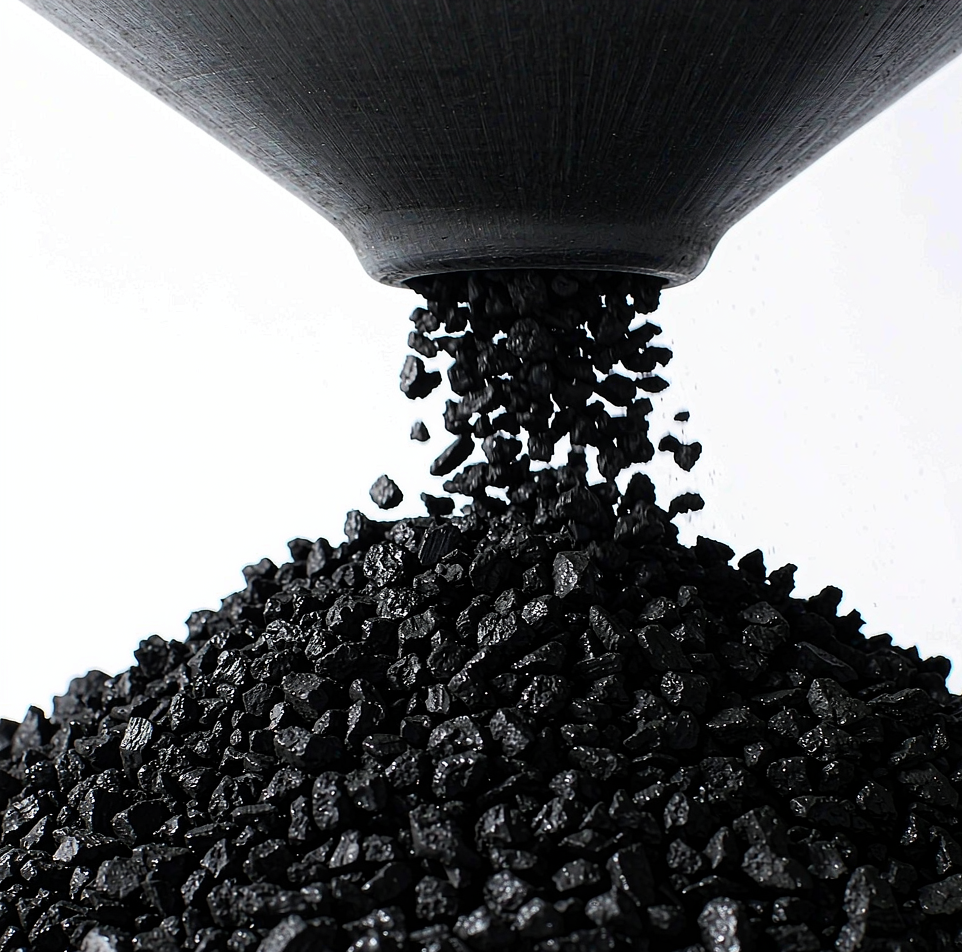
01 Coconut shell GAC
Steam-activated coconut shell gives a hard, microporous carbon with low ash and a pH-neutral surface. It is the default choice where the target is a small molecule: chlorine, chloramine, taste and odour compounds, or gold cyanide complexes. Micropore volume above 0.45 cm³/g delivers the capacity; hardness above 95% keeps it in the vessel.
| Grade | Iodine mg/g | CTC | Hardness | Ash | Bulk density | Mesh | Typical use |
|---|
| HC-C900 | 900 min | 45% | 95% min | ≤3% | 480–520 g/L | 8×30 | Drinking water, dechlorination |
| HC-C1000 | 1,000 min | 55% | 96% min | ≤3% | 470–510 g/L | 8×30 / 12×40 | Gold CIP & CIL, high-purity water |
| HC-C1100 | 1,100 min | 60% | 97% min | ≤2.5% | 460–500 g/L | 12×40 | Gold recovery, catalyst support |
Packaging: 25 kg multi-layer paper bags on pallets, 500 kg jumbo bags, or 20–24 t per 20′ container. Stock grades ship in 7–14 days; custom mesh and iodine targets run 15–25 days.
02 Fruit shell GAC
Apricot kernel, peach and walnut shell carbons sit between coconut and coal: harder than coal, more economical than coconut, with a pore structure that suits gold adsorption and general water polishing. The traditional workhorse of Chinese gold mines, now exported wherever attrition losses matter more than the last 100 mg/g of iodine.
| Grade | Iodine mg/g | CTC | Hardness | Ash | Bulk density | Mesh | Typical use |
|---|
| HC-F800 | 800 min | 40% | 88% min | ≤6% | 500–560 g/L | 6×12 / 8×30 | Gold CIP — economy grade |
| HC-F900 | 900 min | 50% | 90% min | ≤6% | 490–550 g/L | 8×30 | Water polishing, gold leaching |
| HC-F1000 | 1,000 min | 55% | 92% min | ≤5% | 480–540 g/L | 8×30 / 12×40 | Gold recovery, taste & odour |
Raw material rotates with the harvest — apricot and peach shell dominate. The grade specification holds; the botanical origin is stated on the batch certificate.
03 Palm shell GAC
Palm kernel shell carbon is the hardest natural-shell carbon we ship: hardness at or above coconut, higher bulk density, and a micropore structure that loads gold fast. It has become the default in West African and Southeast Asian gold circuits, and a strong option for potable water where bed weight per vessel matters.
| Grade | Iodine mg/g | CTC | Hardness | Ash | Bulk density | Mesh | Typical use |
|---|
| HC-PS950 | 950 min | 55% | 96% min | ≤5% | 520–580 g/L | 6×12 | Gold CIP & CIL |
| HC-PS1000 | 1,000 min | 58% | 97% min | ≤5% | 510–570 g/L | 6×12 / 8×16 | Gold recovery, high-duty water |
| HC-PS1100 | 1,100 min | 60% | 97% min | ≤4% | 500–560 g/L | 8×16 / 8×30 | Potable water, catalyst support |
Bulk density runs 5–10% above coconut — the same vessel holds more kilos. Worth checking before you compare prices per tonne.
04 Coal-based GAC
Reagglomerated bituminous coal gives a broader pore distribution — micropores for small molecules, mesopores for colour bodies and larger organics. The workhorse grade for municipal water and industrial wastewater, and the sensible default when the contaminant mix is not yet characterised.
| Grade | Iodine mg/g | CTC | Hardness | Ash | Bulk density | Mesh | Typical use |
|---|
| HC-K800 | 800 min | 45% | 90% min | ≤10% | 500–540 g/L | 4×8 | Municipal water, pre-treatment |
| HC-K900 | 900 min | 50% | 92% min | ≤12% | 490–530 g/L | 8×30 | Wastewater COD, colour, VOC |
| HC-K1000 | 1,000 min | 55% | 93% min | ≤12% | 480–520 g/L | 8×30 | Solvent recovery, flue gas |
Acid-washed variants (low-ash, ≤5%) are available where leachable metals matter — specify at enquiry. Ash is the number to watch for potable-water duty.
05 Powdered activated carbon — general & potable
Dosed into the process rather than into a bed, PAC is the fast answer to a seasonal problem: an algal bloom, a taste and odour event, or a batch of coloured feedstock. It needs no capital equipment and no change-out schedule — which is why utilities keep it for peaks rather than sizing a bed for the worst week of the year. The HC-DW line is produced for potable duty: selected wood feedstock, acid wash, and batch-reported limits on arsenic, lead and cadmium.
| Grade | Iodine mg/g | Fineness | Moisture | Ash | Methylene blue | Typical use |
|---|
| HC-P700 | 700 min | 200 mesh, 90% pass | ≤5% | ≤12% | 140 mg/g | Taste & odour, general decolourisation |
| HC-P900 | 900 min | 200–325 mesh | ≤5% | ≤10% | 180 mg/g | Algal toxins, seasonal dosing |
| HC-P1000 | 1,000 min | 325 mesh, 90% pass | ≤5% | ≤8% | 200 mg/g | Sugar, starch and oil decolourisation |
| HC-DW900 | 900 min | 200–325 mesh | ≤10% | ≤6% | 180 mg/g | Potable water — taste & odour, algal toxins |
| HC-DW1000 | 1,000 min | 325 mesh, 90% pass | ≤10% | ≤5% | 200 mg/g | Potable water — pesticides, DBP precursors |
Potable-grade line: acid-washed, heavy metals (As, Pb, Cd) reported on every batch certificate — specify when the destination is a drinking-water plant. Typical dose 10–50 mg/L; send a jar sample and we return a dose-response curve. Wood-based PAC is available where mesopore volume matters more than iodine value: a higher molasses number at a lower cost per kilo of colour removed.
06 Columnar (extruded pellet)
Extruded columnar carbon turns granules into cylinders — lower bed resistance, less dust, uniform packing. It is the standard format for solvent recovery beds, gas purification towers and fixed-bed VOC duty where a granular bed would channel or blind. Diameter is a pressure-drop decision: the smaller the pellet, the faster the kinetics and the higher the fan cost.
| Grade | Diameter | CTC | Hardness | Bulk density | Typical use |
|---|
| HC-EX15 | Ø1.5 mm | ≥60% | ≥95% | 400–450 g/L | Air purification, compact beds |
| HC-EX30 | Ø3.0 mm | ≥60% | ≥95% | 420–480 g/L | Solvent recovery, gas towers |
| HC-EX40 | Ø4.0 mm | ≥55% | ≥96% | 430–500 g/L | VOC abatement, biogas pre-bed |
| HC-EX60 | Ø6.0 mm | ≥50% | ≥96% | 450–520 g/L | High-flow duty, low ΔP beds |
Impregnated columnar grades (KI, KOH, sulphur) are produced on the same extrusion line — see family 08. Give us the bed geometry and allowable pressure drop and we propose the diameter.
07 Honeycomb blocks
For high-volume air streams a monolith beats a granular bed on pressure drop. Honeycomb carbon keeps face velocity high and fan energy low, which is why it dominates paint booth and VOC concentrator duty. Water-resistant blocks hold their structure in humid streams and intermittent wash-down.
| Format | Dimensions | Cell density | CTC | Pressure drop | Typical use |
|---|
| HC-H100 | 100×100×100 mm | 1.5–3 mm pitch | ≥50% | Low | VOC abatement, paint booth |
| HC-H50 | 50×50×50 mm | 1.5 mm pitch | ≥45% | Very low | Air purifiers, compact units |
| HC-H100W | 100×100×100 mm | 1.5–3 mm pitch | ≥50% | Low | Humid streams, water-resistant type |
Structured carbon is quoted per cubic metre of block, not per tonne. Give us the face area, bed depth and allowable pressure drop and we size the block count.
08 Impregnated & catalytic carbon
Plain carbon adsorbs; impregnated carbon reacts. Where the target is a gas physical adsorption cannot hold — hydrogen sulphide, mercury vapour, ammonia — the surface is chemically modified to convert it into a stable salt. The specification that matters is breakthrough capacity at your inlet concentration, not the loading percentage.
| Grade | Impregnant | Loading | Target gas | Base carbon | Typical use |
|---|
| HC-I-KI | Potassium iodide | 5% | H₂S, mercaptans | Coal GAC 4 mm | Biogas, sewage odour control |
| HC-I-KOH | Potassium hydroxide | 8–12% | H₂S, acid gases | Coconut GAC | Digester gas, landfill gas |
| HC-I-S | Sulphur | 10% | Mercury vapour | Coal GAC | Incineration, chlor-alkali |
| HC-I-Cu | Copper / silver | 5–8% | Ammonia, amines | Coal GAC | Cold storage, livestock air |
Ask for the breakthrough curve at your conditions. Comparing loading percentages between suppliers compares recipes, not performance.
09 Custom grades
What we can vary
- Iodine value
- 700–1,100
- Mesh split
- 4×8 to 325
- Ash limit
- down to 3%
- Impregnation
- KI · KOH · S · Cu · Ag
- pH adjustment
- Potable duty
What we need from you
- Contaminant
- and inlet level
- Flow rate
- m³/h or gpm
- Vessel
- size and backwash
- Target limit
- regulatory or process
- Annual volume
- for batch sizing
Specification outside these tables? Send the target numbers and the destination market. Most of what we ship is a standard grade with one parameter adjusted — the quotation will say which.