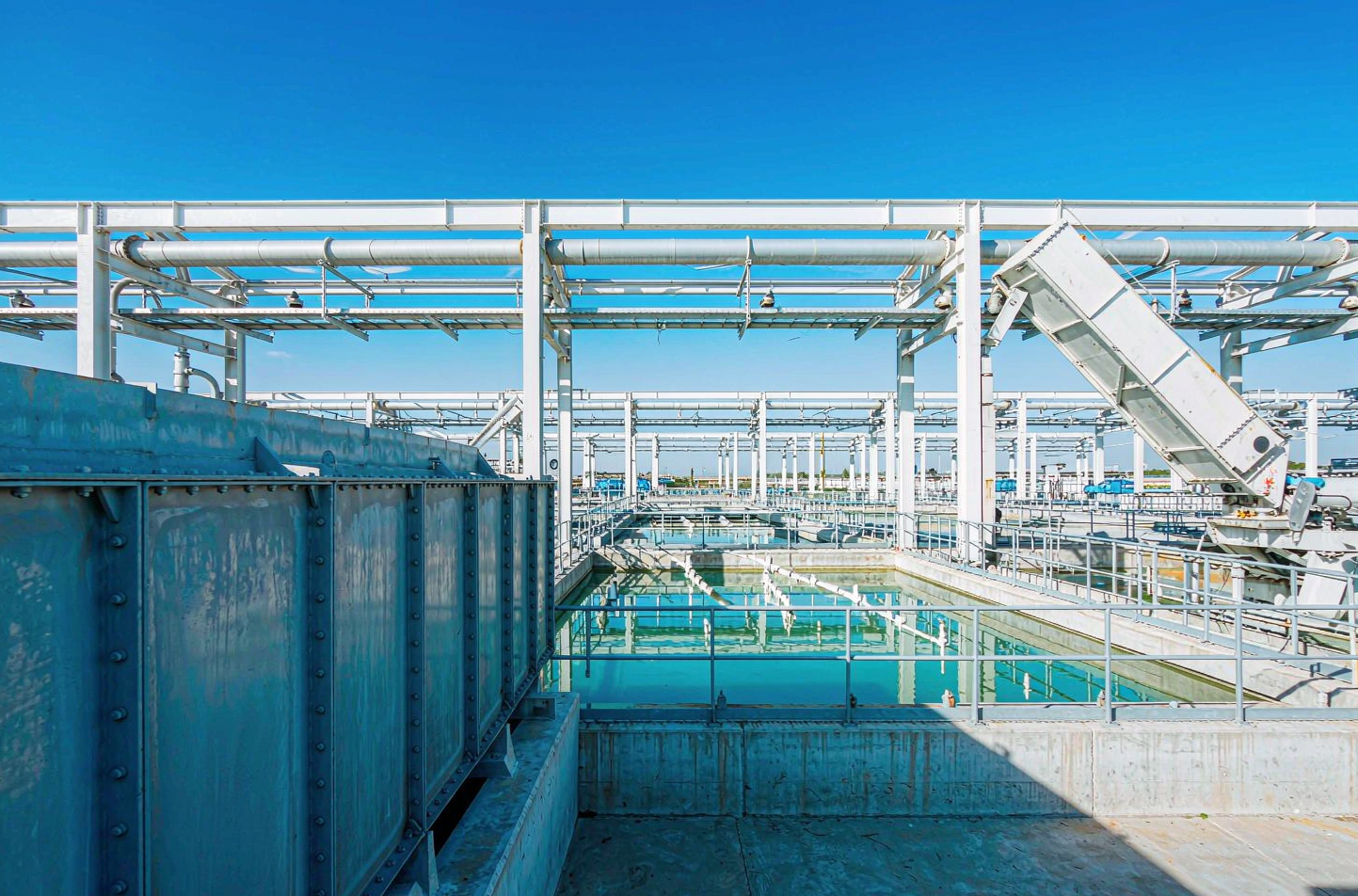
PFAS is the contaminant that turns activated carbon from a commodity purchase into an engineering decision. Long-chain per- and polyfluoroalkyl substances are genuinely adsorbable on granular activated carbon — the technology is proven, regulatory-accepted and widely deployed. The difficulty is not whether GAC works. It is that bed life is short, and every shortcut in sizing is repaid with interest.
For conventional adsorption duties — chlorine, taste and odour — a bed can work at 5–10 minutes of empty bed contact time. Long-chain PFAS need more, because the fluorinated chain resists the adsorption bond and competition from natural organic matter crowds the surface. Current practice and published operating data converge on 10–20 minutes EBCT for long-chain PFAS, with the top of the range where inlet concentrations are high or the water is rich in organic matter.
That number is not a detail — it is the capital cost of the project. Doubling EBCT means doubling media volume and roughly doubling the contactor steel. This is where undersizing does its damage: a contactor built at 5 minutes cannot be corrected by changing carbon more often, because the failure is not exhaustion, it is insufficient contact.
| PFAS fraction | GAC performance | Design EBCT | Expected bed life |
|---|---|---|---|
| Long-chain (PFOA, PFOS, C8+) | Good capacity | 10–20 min | 6–18 months |
| Mid-chain (C6–C7) | Moderate | 15–20 min | 3–9 months |
| Short-chain (C4–C5, PFBS) | Weak — breaks through early | — | IX or RO required downstream |
Bed-life figures are operating ranges from published full-scale data; your water decides. Design from a breakthrough curve, not from this table.
GAC holds long-chain PFAS (PFOA, PFOS and similar) well; short-chain compounds — perfluorobutane sulfonate and the ultrashort chain compounds behind them — adsorb weakly and break through early. No GAC specification fixes this; it is a property of the molecule. Where short-chain PFAS are in the target list, GAC is a partial barrier, and the train needs ion exchange resin or reverse osmosis downstream. A supplier who promises GAC performance across the full PFAS family is not reading the same literature you should.
Operating data from full-scale plants puts long-chain PFAS bed life between roughly 6 and 18 months, depending on inlet concentration, organic competition and EBCT. The spread is why design must be based on a breakthrough curve for the actual water, not on a catalogue claim. Breakthrough testing is not exotic: a small column at the design EBCT, sampled on a schedule, produces the curve in weeks.
Ask for a breakthrough model against your inlet data, the design EBCT they would commit to, and — the honest answer — which PFAS compounds their carbon handles well and which it does not. The supplier who volunteers the short-chain limitation is the one who has actually run the columns.
Ten technical notes · no email gate
Finer mesh buys kinetics and costs pressure drop. Picking a split from vessel size, backwash rate and allowable head loss — not from habit.
Spent carbon is a resource with a transport cost attached. A break-even calculation for thermal reactivation at different scales and distances.
Why acid-washed grades exist, what they remove, and when the extra cost is justified by the regulatory limit you must meet.
A jar test says whether carbon adsorbs. A column test says when the bed breaks through. How to run one that survives contact with the plant.
Contaminant, inlet level, flow rate, target limit — four numbers are enough for a first recommendation and a media volume estimate.